Taking a Creative Workflow Product From Figma to Production Across Web, Mobile and Admin
Taking a Creative Workflow Product From Figma to Production Across Web, Mobile and Admin
SaaS
Mobile App
Admin Platform
Product Delivery
The Requirement
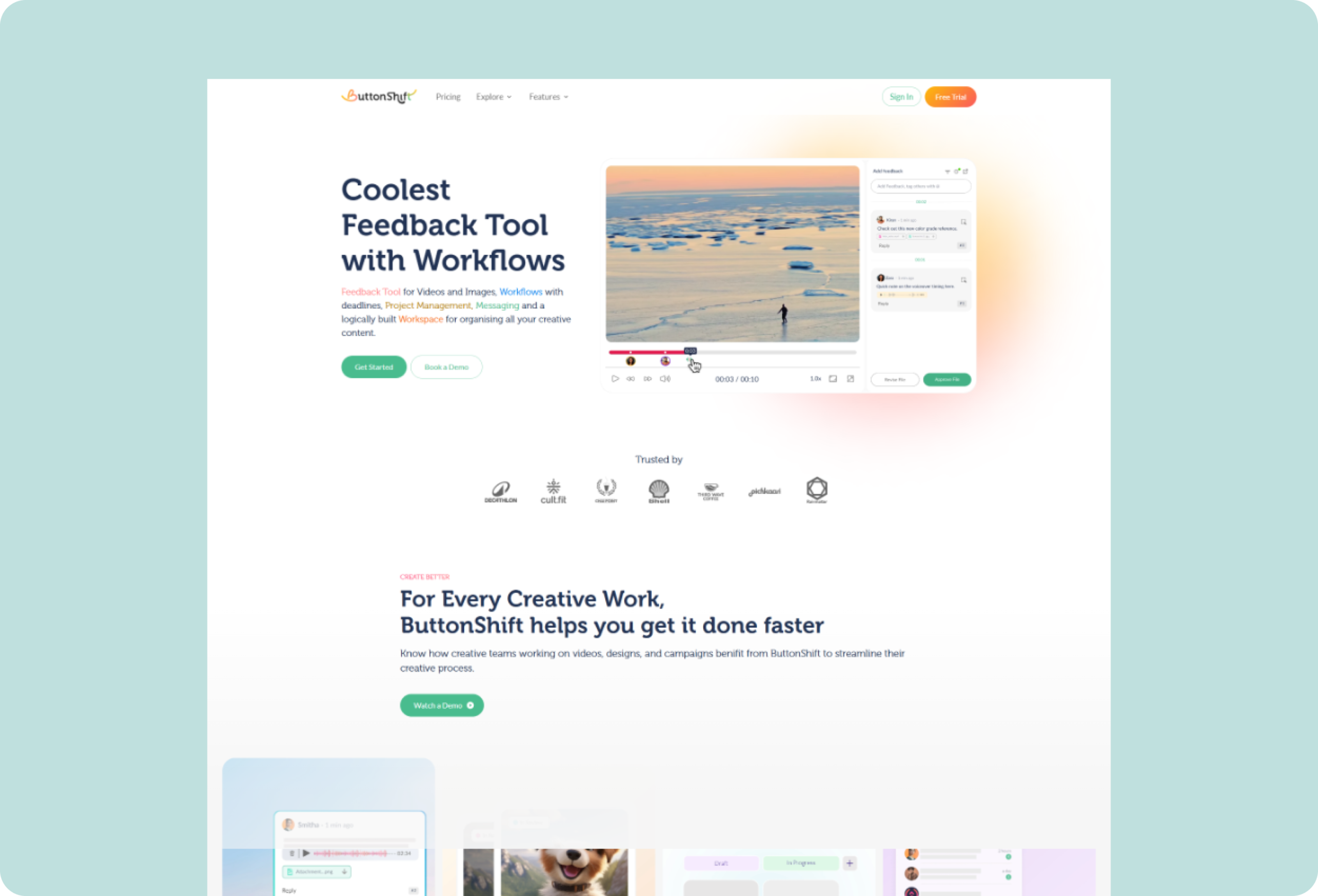
ButtonShift was building a creative workflow product that needed coordinated execution across multiple product surfaces rather than a single application.
The project involved the core SaaS platform along with mobile and administrative workflows, with implementation being carried out across different development resources.
The requirement was not simply additional development bandwidth. The product needed a team that could keep design, development and QA aligned while moving the different parts of the platform toward production.
The engagement needed to cover:
SaaS product delivery;
mobile application development;
admin workflows;
implementation from approved Figma designs;
coordination across third-party development resources;
QA and execution oversight;
production delivery.
Our Role
We worked as an external product delivery and engineering team, helping coordinate execution across the different parts of the product.
Our scope included:
SaaS product delivery and implementation;
mobile application coordination;
admin panel development coordination;
Figma-to-development execution;
translating approved user journeys into implementation requirements;
working with third-party development resources;
reviewing implementation quality;
QA oversight;
issue and dependency coordination;
supporting the product through production delivery.
A major part of our role was maintaining continuity between design, product requirements and engineering even when the implementation involved multiple teams.
Rather than requiring the client to independently manage every development stream, we provided a central layer of technical and delivery ownership.
The Solution
We structured the engagement around the product as a whole rather than treating the SaaS platform, mobile application and admin environment as independent development assignments.
The delivery workflow connected:
Figma & Product Requirements → Development Coordination → Web, Mobile & Admin Implementation → QA → Issue Resolution → Production
From Design to Working Product
Approved Figma designs provided the visual and experience foundation, but moving from design files to a functioning product required continuous interpretation and coordination.
Our team worked across implementation to ensure that:
user journeys were translated correctly into development;
interactions remained consistent with approved designs;
different parts of the product followed the same underlying workflow;
implementation gaps were identified during QA;
issues were resolved before production delivery.
This was particularly important because the product extended across more than one interface.
Coordinating Multiple Product Surfaces
The platform required execution across:
the core SaaS product;
mobile application;
administration workflows.
Changes in one area could affect another, which made coordination important throughout development.
Instead of allowing these workstreams to progress independently, we helped maintain alignment across the wider product experience.
Managing Third-Party Development
The engagement also involved third-party development resources.
Our role included working with those teams as part of the overall delivery structure rather than expecting the client to manage each resource separately.
This involved:
communicating implementation requirements;
monitoring development progress;
reviewing outputs;
identifying discrepancies;
coordinating fixes;
maintaining QA oversight;
keeping different workstreams moving toward the same release.
The value was therefore not only in developing features, but in providing the execution layer required to move a distributed product team from designs to production.
Operational Outcome
The engagement gave ButtonShift a more coordinated delivery structure across its SaaS, mobile and administrative product development.
It helped the team:
manage multiple development streams through one execution layer;
maintain closer alignment between Figma designs and production implementation;
coordinate third-party development resources;
identify and resolve implementation issues through structured QA;
maintain consistency across web, mobile and admin workflows;
move product development toward production without independently managing every technical workstream.
The result was an external delivery capability that could work alongside the existing product team and take responsibility for turning approved product direction into coordinated technical execution.
The engagement gave ButtonShift a more coordinated delivery structure across its SaaS, mobile and administrative product development.
It helped the team:
manage multiple development streams through one execution layer;
maintain closer alignment between Figma designs and production implementation;
coordinate third-party development resources;
identify and resolve implementation issues through structured QA;
maintain consistency across web, mobile and admin workflows;
move product development toward production without independently managing every technical workstream.
The result was an external delivery capability that could work alongside the existing product team and take responsibility for turning approved product direction into coordinated technical execution.
We work across ecommerce and D2C, retail, beauty and wellness, travel, fitness, SaaS, real estate and enterprise operations. Our focus is less on a specific industry and more on solving complex digital, product and workflow requirements.
Yes. We design and develop web applications, responsive platforms, iOS and Android apps, SaaS products, internal tools, customer portals and admin systems depending on the business requirement.
Yes. We build custom systems that replace repetitive manual workflows, connect teams and bring operational information into one place. This can include CRMs, approval workflows, field applications, booking systems, vendor management, reporting and other internal business processes.
Yes. We work on applications where AI is part of a larger product or workflow, including image analysis, recommendation systems, brand intelligence, data analysis and AI-assisted decision-making tools.
Yes. We work on Shopify stores from UI/UX and catalogue architecture through development, custom product journeys, multilingual setups, Shopify POS, loyalty, fulfilment, product configurators and other custom commerce requirements.
Yes. Our projects regularly involve APIs and third-party systems such as CRMs, payment gateways, communication platforms, travel systems, AI services, ecommerce tools and other business software.
Yes. We work with agencies and technology partners as an external engineering and delivery team, including white-label engagements where we operate behind the partner’s brand.
Yes. We can get involved from the initial requirement stage, help structure the product and technical approach, design the experience, build the application, manage QA and support deployment and subsequent development.
Share your requirement with us at connect@tenetquad.com or call +91 9316877761. You can also visit tenetquad.com to start a conversation about your project.